
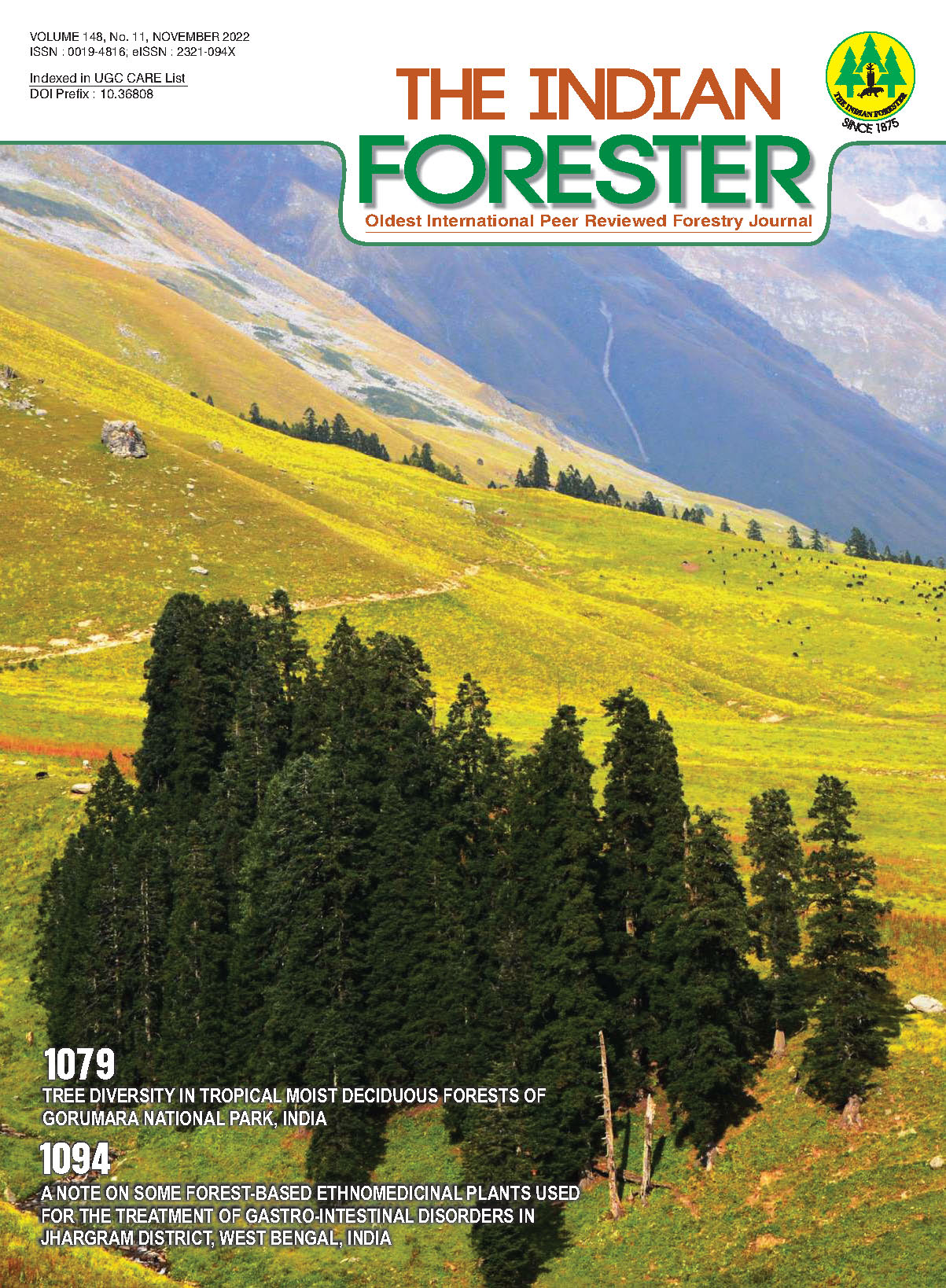
Tree Diversity in Tropical Moist Deciduous Forests of Gorumara National Park, India
DOI:
https://doi.org/10.36808/if/2022/v148i11/169264Keywords:
Diversity indices, Eastern Himalaya, Gorumara National Park, MPCA, NTFPAbstract
Exploration of the diverse tree species in moist deciduous forests is the urgent need to conserve and restore the degraded forest ecosystem in this sub-Himalayan Terai-Duars part of Eastern India. From Red Data Book and IUCN Red List their threatened status and diversity in the unique ecosystem of Gorumara National Park (GNP), India, were assessed carefully to develop baseline data for natural resource study that will help to prepare a master plan for proper conservation of the sustainable ecosystem of the national park. The study used random sampling in different seasons in various microhabitats within the National Park. The diversity of trees was observed, with 315 taxa representing 198 genera belonging to 61 families. Phytosociology and diversity of the tree layer was also analysed through quadrate sampling. The study reflects very rich tree diversity in the area, with 211 species of wild medicinal plants and NTFP species frequently used in indigenous medicine systems and other uses by locals. The study also reveals that the forest provides a unique environment for wildlife by maintaining an ideal ecosystem and acting as a wildlife corridor by connecting several nearby forest landscapes.References
Banerjee L.K. (1993). Plant resources of Jaldapara Rhino Sanctuary. Botanical Survey of India, Calcutta.
Champion G.H. and Seth S.K. (1968). A revised survey of the forest types of India. Govt. of India, New Delhi.
Chitale V.S., Behera M.D. and Roy P.S. (2014). Future of Endemic Flora of Biodiversity Hotspots in India, PLOS ONE, 9(12): e115264.
Chowdhury M. (2009). Plant Diversity and Vegetation Structure in the Wetlands of Malda District of West Bengal, India, Ph.D. Thesis, University of North Bengal, West Bengal, India.
Das A.P. (2002). Survey of naturalised exotics in the flora of Darjiling Hills, West Bengal, (India), Journal of Economic and Taxonomic Botany, 26: 31–37.
Gamble J.S. (1875). The Darjeeling forests, Indian Forester, 2: 73–99.
Grierson A.J.C. and Long D.G. (1983, 1994, 1987). Flora of Bhutan. Royal Botanical Garden, Edinburgh, Vol. 1 (1, 2 and 3).
Grierson A.J.C. and Long D.G. (1991, 1999, 2001). Flora of Bhutan. Royal Botanical Garden, Edinburgh, Vol. 2 (1, 2 and 3).
Hara H. (1966). Flora of Eastern Himalaya. Tokyo University, Tokyo. Hara H. and Williams L.H.J. (1979). An Enumeration of the Flowering Plants of Nepal. British Museum of Natural History, London, Vol. II.
Hara H., Chater A.Q. and Williams L.H.J. (1982). An Enumeration of the Flowering Plants of Nepal.British Museum of Natural History, London, Vol. III.
Hara H., Stearn W.T. and Williams L.H.J. (1978). An Enumeration of the Flowering Plants of Nepal. British Museum of Natural History, London, Vol. 1.
Hooker J.D. (1872 – 1897). The Flora of British India. L. Reeve and Co. Ltd, London, Vols 1-7.
IUCN (2019). The IUCN Red List of Threatened Species. Version 2019-4. accessed on 25 July 2021.
Jain S.K. and Rao R.R. (1977). A Handbook of Field and Herbarium Methods. Today and Tomorrow's Printers and Publishers, New Delhi, India.
Kumar A., Marcot B.G. and Saxena A. (2006). Tree species diversity and distribution patterns in tropical forests of Garo Hills, Current Science, 91: 1370–1381.
Margalef R. (1968). Information theory of ecology.Journal of General Systems, 3: 36–71.
Menhinick E.F. (1964). A comparison of some species diversity indices applied to samples of field insects. Ecology, 45: 858–861.
Nayar M.P. and Sastry A.R.K. (1987, 1990). Red Data Book of Indian Plants. Botanical Survey of India, Calcutta, Vol. 1 and 3.
Noltie H.J. (1994, 2000). Flora of Bhutan. Royal Botanical Garden, Edinburgh, Vol. 3 (1 and 2).
Ohashi H. (1975). The Flora of Eastern Himalaya. 3rd Report, Tokyo University, Tokyo.
Olson D.M. and Dinerstein E. (2002). The Global 200: Priority Eco regions for Global Conservation, Annals of Missouri Botanical Garden, 89: 199–224.
Olson D.M., Dinerstein E., Wikramanayake E.D., Burgess N.D., Powell G.V.N., Underwood E.C., D'amico J.A., Illanga I., Strand H.E., Morrison J.C., Loucks C.J., Allnutt T.F., Ricketts T.H., Kura Y., Lamoreux J.F., Wettengel W.W., Hedao P. and Kassem K.R. (2001). Terrestrial Ecoregions of the World: A New Map of Life on Earth, BioScience, 51: 933–938.
Pandit P.K. (1996). Management plan of Jaldapara Wildlife Sanctuary, West Bengal (Vols. I– III). Wildlife Circle, Department of Forest, Government of West Bengal.
Pandit P.K., Ghosh C. and Das A.P. (2004). Non-Timber Forest Products of Jaldapara Wildlife Sanctuary: An assessment, Indian Forester, 130(10): 1169–1185.
Paul P., Dhar S., Das D. and Chowdhury M. (2020). Herberium Technique. Orange Book Publication, Chhattisgarh, India.
Prain D. (1903). Bengal Plants. West, Newman & Co, London, Vol. I & II.
Rai U. (2006). Plant Biodiversity Characterization in Darjiling Hills using Remote Sensing technique, Ph.D Thesis, University of North Bengal, West Bengal. India.
Ranjan V. and Kumar A. (2015). Floristic Diversity in Gorumara National Park, West Bengal.Journal of Non-Timber Forest Products, 22: 97–102.
Ray M., De P.P. and Ryngnga P.K. (2018). Anthropogenic Threats to Bio-Diversity in Gorumara National Park, West Bengal, India, International Journal of Ecology and Development, 33: 156–165.
Saha G. (2018). Spermatophytic flora of Gorumara National Park in the Duars of West Bengal India, Ph.D Thesis, University of North Bengal, West Bengal, India.
Shannon C.E. and Weiner W. (1963). The Mathematical Theory of Communication. University of Illinois press, USA, pp. 111.
Sikdar J.K. (1984). Contribution to the flora of Baikunthapur forest Division Jalpaiguri district (West Bengal), Journal of Economic and Taxonomic Botany, 5: 505–532.
Simpson E.M. (1949). Measurement of diversity. Nature, 163: 688.
Downloads
Downloads
Published
How to Cite
Issue
Section
License
Unless otherwise stated, copyright or similar rights in all materials presented on the site, including graphical images, are owned by Indian Forester.


