
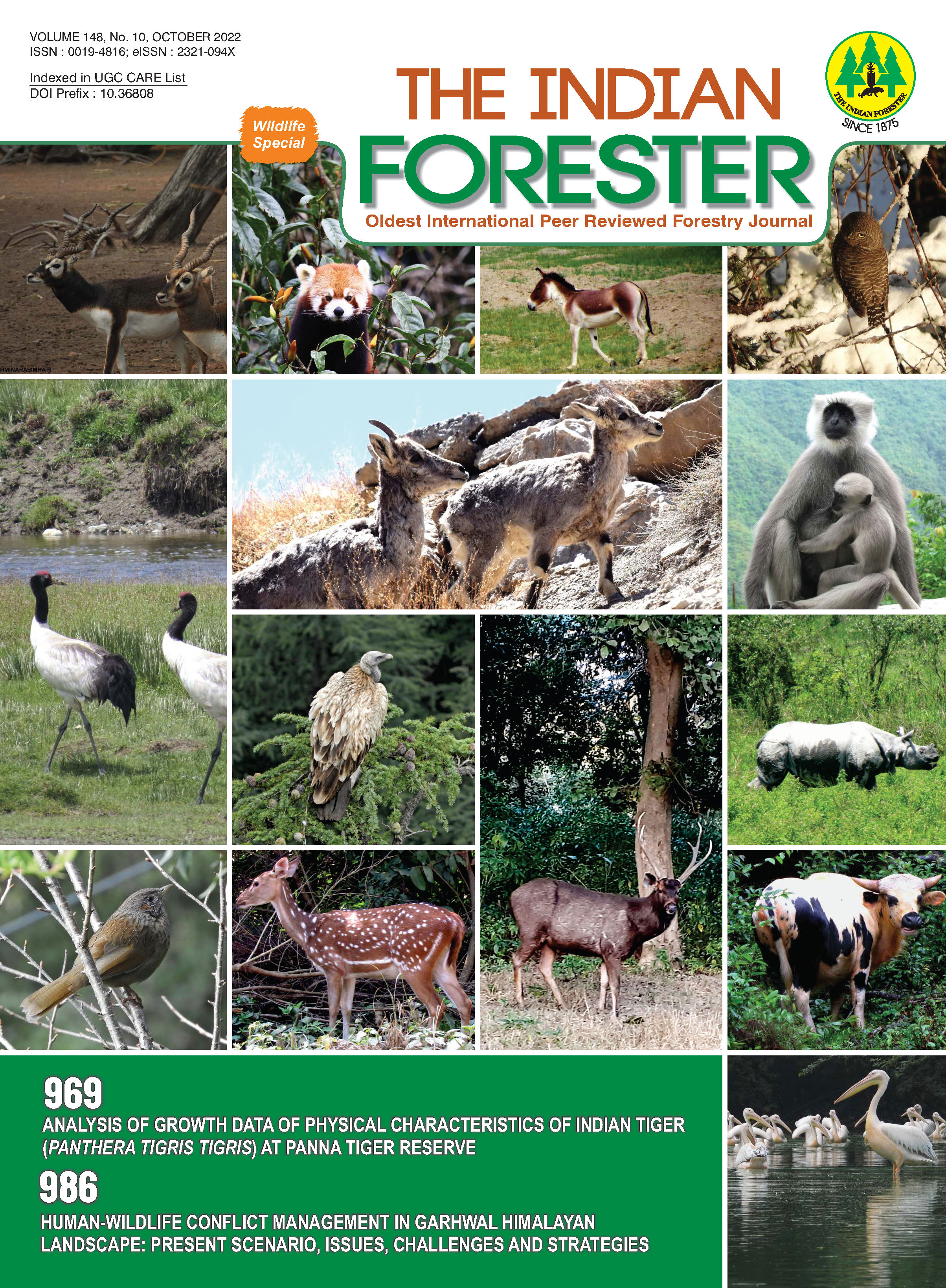
Human-Wildlife Conflict Management in Garhwal Himalayan Landscape: Present scenario, Issues, Challenges and Strategies
DOI:
https://doi.org/10.36808/if/2022/v148i10/159767Keywords:
Human-wildlife conflict, Narendranagar forest division, Livestock predationAbstract
Human-wildlife conflict is an important issue in Uttarakhand for many decades. Severe loss incurred in terms of livestock predation, human injury, and death along with the crop raiding. Due to anthropogenic pressures on the wildlife habitats, large groups of wild animals are forced to occupy the multiuse landscapes outside the reserve forest areas. About 645 incidents have been recorded with a total of 740 casualties of livestock predation along with 126 incidents of human injured and 36 incident of human death in Narendranagar forest division between the periods of 2000 - 2020. Maximum attacks by wild animals were recorded when livestock was freely grazing without herder within the multi-use land. Leopard and elephant were mainly involved in human death whereas elephant and monkey in crop raiding. Present study also suggests supervised grazing, awareness of leopard prone areas, removing of unnecessary canopy of plants to reduce the conflicts cases in the study area. Further, the areas demand culturally and sustainable acceptable strategies to mitigate the damages and a comprehensive Human-Wildlife management plan should be formulated and implemented in each ranges of Narendranagar forest division.References
Banerjee K., Jhala Y.V., Chauhan K.S. and Dave C.V. (2013). Living with lions: the economics of coexistence in the Gir forests, India. PLoS One, 8(1): 1–11.
Balme G., Hunter L. and Slotow R.O.B. (2007). Feeding habitat selection by hunting leopards Panthera pardus in a woodland savanna: prey catchability versus abundance. Animal Behaviour, 74(3): 589-598.
Bibi S.S., Minhas R.A., Awan M.S., Ali U. and Dar N.I. (2013). Study of ethno-carnivore relationship in dhirkot, azadjammu and kashmir (pakistan). Journal of Animal and Plant Sciences, 23: 854-859.
Bernard H.R. (1995). Research methods in anthropology: quantitative and qualitative approaches. Sage, Thousand Oaks.
Brooks A. (2014). Human Tiger Conflict Discussion Paper, WWF Tigers Alive Initiative, WWF International.
Corbett J. (1948). The man-eating leopard of Rudraprayag. Oxford University Press. New Delhi.
Dhanwatey H.S., Crawford J.C., Abade L.A., Dhanwatey P.H., Nielsen C.K. and Sillero-Zubiri C. (2013). Large carnivore attacks on humans in central India: a case study from the Tadoba-Andhari Tiger Reserve. Oryx, 47(2): 221-227.
Dar N.I., Minhas R.A., Zaman Q. and Linkie M. (2009). Predicting the patterns, perceptions and causes of human–carnivore conflict in and around Machiara National Park, Pakistan. Biological Conservation, 142(10): 2076-2082.
Dickman A.J., Macdonald E.A. and Macdonald D.W. (2011). A review of financial instruments to pay for predator conservation and encourage human–carnivore coexistence. Proceedings of the National Academy of Sciences, 108(34): 13937-13944.
Goodrich J.M. (2010). Human-tiger conflict: a review and call for comprehensive plans. Integrative Zoology, 5(4): 300–312.
Guo X.M., He Q.C., Wang L.X., Yang Z.B., Li Z.Y. and Zhu Z.Y. (2012). Effects of Asian elephant food source base on the mitigation of human-elephant conflict in Xishuangbanna of Yunnan Province, Southwest China. Chinese Journal of Ecology, 31(12): 3133-3137.
Harihar A., Ghosh-Harihar M. and MacMillan D.C. (2014). Human resettlement and tiger conservation–socio-economic assessment of pastoralists reveals a rare conservation opportunity in a human-dominated landscape. Biological Conservation, 169: 167-175.
Hemson G., Maclennan S., Mills G., Johnson P. and Macdonald D. (2009). Community, lions, livestock and money: a spatial and social analysis of attitudes to wildlife and the conservation value of tourism in a human–carnivore conflict in Botswana. Biological Conservation, 142(11): 2718-2725.
Hoffman T.S. and O'Riain M.J. (2012). Monkey management: using spatial ecology to understand the extent and severity of human–baboon conflict in the Cape Peninsula, South Africa. Ecology and Society, 17(3): 13-21.
Jackson R. (2012). Fostering community-based stewardship of wildlife in Central Asia: Transforming snow leopards from pests into valued assets, Rangeland Stewardship in Central Asia, Springer, Dordrecht Heidelberg, New York, London, 357-380.
Karanth K.K. and Kudalkar S. (2017). History, location, and species matter: insights for human–wildlife conflict mitigation from India. Human dimensions of wildlife, 22(4): 331-346.
Karanth K.K., Naughton-Treves L., DeFries R. and Gopalaswamy A.M. (2013). Living with wildlife and mitigating conflicts around three Indian protected areas. Environmental management, 52(6): 1320-1332.
LeCompte M. and Schensul J. (1999). Analyzing and interpreting ethnographic data. Walnut Creek, Altamira.
Mamgain P.R. and Redd D.N. (2015). Outmigration from hill region of Uttarakhand: Magnitude Challenges and Policy Options, Final Report. National Institute of Rural Development and Panchayati Raj.
Marchal V. and Hill C. (2009). Primate crop-raiding: a study of local perceptions in four villages in North Sumatra, Indonesia. Primate Conservation, 24(1): 107-116.
Madden F.M. (2008). The growing conflict between humans and wildlife: law and policy as contributing and mitigating factors. Journal of International Wildlife Law & Policy, 11(2-3): 189-206.
Ogra M.V. (2008). Human–wildlife conflict and gender in protected area borderlands: a case study of costs, perceptions, and vulnerabilities from Uttarakhand (Uttaranchal), India. Geoforum, 39(3): 1408-1422.
Prins H.H.T. and J.G. Grootenhuis. (2000). Introduction: the value of priceless wildlife. Pages 1–12 in H. H. T. Prins, J. G. Grootenhuis, and T. T. Dolan, editors. Wildlife conservation by sustainable use. Kluwer Academic, Boston, Massachusetts, USA.
Pettigrew M., Xie Y., Kang A., Rao M., Goodrich J., Liu T. and Berger J. (2012). Human–carnivore conflict in China: a review of current approaches with recommendations for improved management. Integrative Zoology, 7(2): 210-226.
Ripple W.J., Estes J.A., Beschta R.L., Wilmers C.C., Ritchie E.G., Hebblewhite M., ... and Schmitz O.J. (2014). Status and ecological effects of the world's largest carnivores. Science, 343: 6167-6172.
Seidensticker J. and Lumpkin S. (1991). Great Cats, majestic creatures of the wild. Pennsylvania Rodale Press, 1- 240.
Thirgood S., Woodroffe R. and Rabinowitz A. (2005). The impact of human–wildlife conflict on human lives and livelihoods. Conserv. Biol. Ser. Camb., 9: 13.
Treves A. and Karanth K.U. (2003). Human-carnivore conflict and perspectives on carnivore management worldwide. Conservation biology, 17(6): 1491-1499.
USAID. (2013). U. S. Agency for International Development), Agricultural Growth Program (AGP) - Livestock Market Development (LMD): Cost-benefit analysis of the meat value chain in Ethiopia, Final Report. (AID-OAA-C-11-00169).
Downloads
Downloads
Additional Files
Published
How to Cite
Issue
Section
License
Unless otherwise stated, copyright or similar rights in all materials presented on the site, including graphical images, are owned by Indian Forester.


