
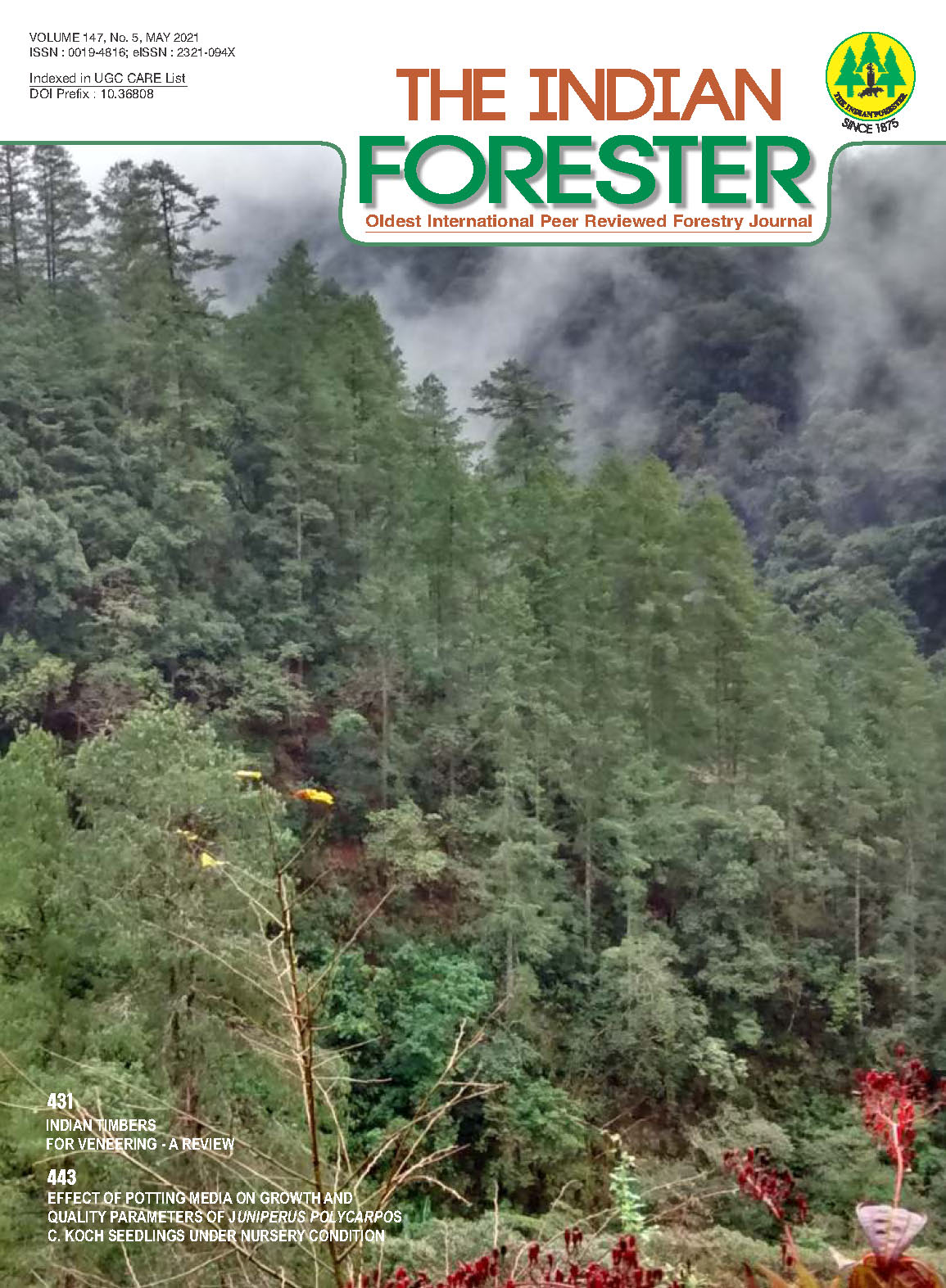
Indian Timbers for Veneering - A Review
DOI:
https://doi.org/10.36808/if/2021/v147i5/154878Keywords:
Plywood, Wood Based Panels, Agroforestry, Plantation Timbers, Short Rotation, Secondary Species.Abstract
Conservation oriented forest management policies and total ban on commercial logging from natural forest has led the plywood industry in India to a situation of shortage of traditional timber raw material which is used for manufacturing wood based panels. The shortage of raw materials has forced many wood based product mills to operate below their installed production capacities. The wood based industries in India are managing to survive on the availability of timber outside forest, secondary species and other lesser known Indian hardwoods. The industry is dependent on imported timber species to some extent as a source of raw material.
Under this circumstance, the study on lesser known Indian hardwoods which can be grown in agro forestry and farm forestry plantation will help in making use of these species for plywood manufacturing and thereby ensuring uninterrupted supply of raw materials for production of plywood and other wood based panels. Keeping this in view, a series of studies has been carried out at Indian Plywood Industries Research and Training Institute (IPIRTI) to investigate the suitability of secondary species of timbers or lesser known Indian hardwoods especially the short rotation plantation grown timbers for the manufacture of plywood. This is a compilation of the outcome of such studies carried out at IPIRTI.
References
Bing. Xue and Hu Yingcheng (2013). Analysis of the microstructure and mechanical properties of laminated veneer lumber, BioRes. 8(2): 2681-2695.
Chauhan R.S., Jadeja D.B., Thakur N.S., Jha S.K. and M.S. Sankanur. (2018). Selection of Candidate Plus Trees (CPTs) of Malabar Neem (Melia dubia Cav.) for Enhancement of Farm Productivity in South Gujarat, India. Int.J.Curr.Microbiol.App.Sci., 7(5): 3582-3592.
Chudnoff Martin. (1984). Tropical timbers of the world. Agric. Handb. 607. Washington, DC: U.S Department of Agriculture. Page 244.
Darmawan W., Nandika D., Massijaya Y., Kabe A., Rahayu I., Denaud L. and Ozarska B. (2015). Lathe check characteristics of fast growing sengon veneers and their effect on LVL glue-bond and bending strength. J Mat Processing Technol., 215: 181-188.
Devallance D., Funck J.W. and Reeb J. (2007). Douglas-fir plywood gluebond quality as influenced by veneer roughness, lathe checks, and annual ring characteristics. Forest Products Journal, 57: 21-28.
Deng Jianchao, Haidong Li, Dan Zhang, Fuming Chen, Ge Wang and Haitao Cheng. (2014). The effect of joint form and parameter values on mechanical properties of bamboobundle laminated veneer lumber (BLVL). Bio Resources, 9(4): 6765-6777.
Kollmann F., Kuenzi E.W. and Stamm A.J. (1975). Principles of wood science and technology II: wood based materials. United State (US): Springer Berlin Heidelberg. New York. pp. 123-132.
Leney L. (1960). A photographic study of veneer formation. For.Prod. J., 10: 133- 139.
Lutz J.F. (1971). Wood and Log Characteristics Affecting Veneer Production. USDA Forest Service Research Paper FPL150.
Lutz J.F. (1974). Techniques for peeling process, slicing, drying veneer. United State (US) FPL, Forest Ser. USDA, 228 pp Lutz J.F. (1978). Wood veneer: Log selection, cutting and drying. Forest Service, US Department of Agriculture, Technical Bulletin No.: 1577. 137p.
Lutz John. (2017). Techniques for Peeling, Slicing, and Drying Veneer. US for Prod Lab Res Pap. 68.
Mac Millan, W.C., (1958). The relation of mechanical properties of wood and nose bar pressure in the production of veneer, Forest Products Journal, 8(1):28.
Malaysian Forest Service, (1982). Trade leaflet No. 58. Malaysian Timbers - Rubber wood, The Malaysian Timber Industry Board.
Mathews K.C., Mohandas K.K., Uday N.D., Sujatha D. and A.K. Bansal (2003). Plywood from Plantation Species - Paraserienthes odoratissima and Paraserientheslebbek. Indian Forester [Online], 129.11: 1370-1378. Web. 29 Jun. 2020.
Mathews K.C. Rangaraju T.S., Venugopal Naidu M. and Padmanabhan S. (1987). Investigations on the suitability of plantation grown Eucalyptus tereticornis from Neyveli for plywood and sawn timber. IPIRTI Res. Report No.24.
Mathews K.C., Narayanaprasad T.R and Zoolagud S.S. (1997). Studies on peeling, drying and gluing characteristics of lesser known Indian hardwoods (Poplar, Wodier and Silver oak), IPIRTI Research Report No.100.
Mathews K.C., Chandrasekhar Rao A.S., Narayanaprasad T.R. and Zoolagud S.S. (1993). Studies on peeling, drying and gluing characteristics of lesser known Indian hardwoods IPIRTI Research Report No.66.
Nath S.K. (2009). Plywood Manufacturing Practices in India. DVS publications., New Delhi.
Nautiyal Ismita and Gautam Shilpa. (2015). Suitability of combination plywood from Melia composita and Populus deltoides and effect of curing pressure on their glue shear strength. Journal of Tree Sciences, 34(2): 47-51.
Nazma Ganapathy P.M., Sasidharan N., Bhat K.M. and Gnanaharan R. (1981). A handbook of Kerala timbers. Research Report 9. Kerala Forest Reserach Institute, Peechi, India. 260 p.
Pandey C. N. and Roy S. (2020). Plywood and Panel Industry in India - Current scenario and key issues. IWST. Bangalore. (Communicated for publication).
Pearson R.S. and Brown H.P. (1932). Commercial timbers of India: their distribution, supplies, anatomical structure, physical and mechanical properties and uses. Reprinted. Bishen Singh and Mahendra Pal Singh, Dehradun, India. 1150 p.
Ramazan Kurt, Kagan Aslan, Muhammet Cil and Vedat Cavus. (2012). Properties of parallel strand lumber from two hybrid poplar clones using melamine urea formaldehyde adhesive. BioResources, 7(3): 3711- 3791.
Rohumaa A., Hunt C.G., Hughes M., Frihart C.R. and Logren J. (2013). The influence of lathe check depth and orientation on the bond quality of phenol-formaldehyde-bonded birch plywood. Holzforschung. 67. 10.1515/hf-2012-0161.
Sedjo R.A. (1999). The potential of high-yield forestry for meeting timber needs. New Forests 1-3 pp.
Sivananda V. (1972). Veneer lathe settings and quality of veneer peeled. IPIRI Journal. 2(21): 1-7.
Downloads
Downloads
Additional Files
Published
How to Cite
Issue
Section
License
Unless otherwise stated, copyright or similar rights in all materials presented on the site, including graphical images, are owned by Indian Forester.


