
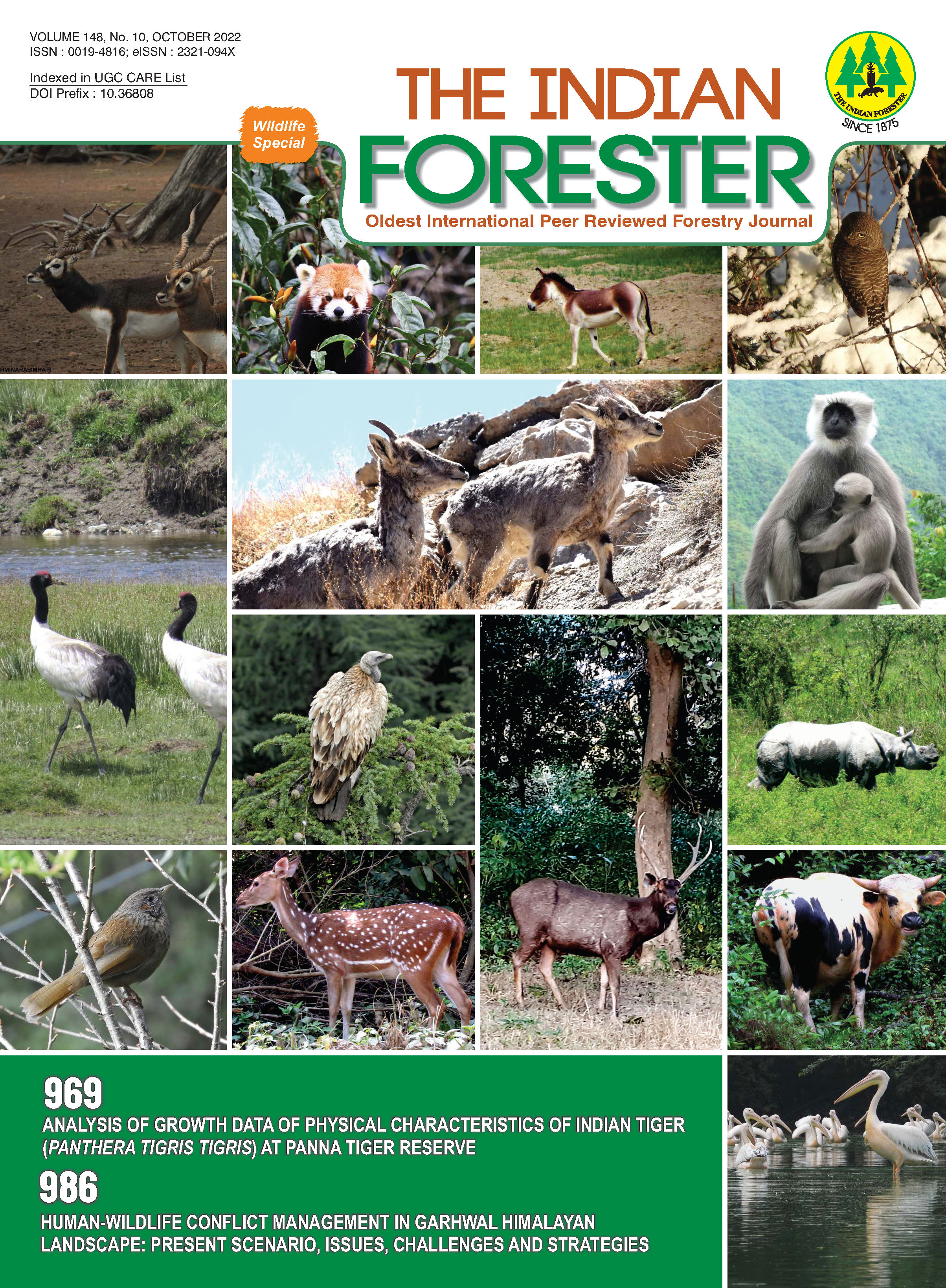
Food plants and feeding habits of ungulates at Panna Tiger Reserve, Madhya Pradesh, India
DOI:
https://doi.org/10.36808/if/2022/v148i10/159953Keywords:
Ungulate, Food habits, Mixed feeder, Panna Tiger Reserve, Browse, IVI.Abstract
The food and feeding habits of ungulates present in the Panna Tiger Reserve were studied by direct field observations from January 2019 to May 2019.The aim of the study was to explore the composition of the diet, preferable plant species, and variation in diet consumption among five sympatric ungulate species i.e. Chital (Axis axis), Sambar (Rusa unicolor), Nilgai (Boselaphus tragocamelus), Chinkara (Gazella bennettii), Chousingha (Tetracerus quadricornis). The Important Value Index of all the food plants was calculated to check the availability of food plants. The results showed that the diet of ungulates consisted of diverse species of plants. Ungulates were seen feeding on 89 specie out of which 53 are tree species and 36 are herb and shrub species. Plant species were belonging to 28 families with 21% contributing from Poaceae, and 12% from Rubiaceae. The results are based on 255 observations of sambar, 295 observations of chital, 341 observations of nilgai, 219 observations of chinkara, and 69 observations of chousingha. Plants provide a healthy environment for Herbivores as they are solely dependent on them for food.References
Abrams P.A. (1998). High competition with low similarity and low competition with high similarity: exploitative and apparent competition in consumer–resource systems. Am Nat., 152: 114-128.
Abrams P. (1980). Some comments on measuring niche overlap. Ecology, 61(1): 44-49.
Ahrestani F.S., Heitkönig I.M., Matsubayashi H. and Prins H.H. (2016). Grazing and browsing by large herbivores in South and Southeast Asia. In The Ecology of Large Herbivores in South and Southeast Asia (pp. 99-120). Springer, Dordrecht.
Altmann J. (1974). Observational study of behavior: sampling methods. Behaviour, 49(3-4): 227-266.
Arsenault R. and Owen-Smith N. (2002). Facilitation versus competition in grazing herbivore assemblages. Oikos, 97(3): 313-318.
Baskaran N., Kannan V., Thiyagesan K. and Desai A.A. (2011). B e h a v i o u r a l e c o l o g y o f f o u r - h o r n e d a n t e l o p e (Tetracerusquadricornis de Blainville, 1816) in the tropical forests of southern India. Mammalian Biology, 76(6):741-747.
Bell R.H. (1971). A grazing ecosystem in the Serengeti. Scientific American, 225(1):86-93.
Belovsky G.E. (1997). Optimal foraging and community structure: the allometry of herbivore food selection and competition. Evolutionary Ecology, 11(6): 641-672.
Berwick S. (1976). The Gir Forest: an endangered ecosystem. American Scientist, 64(1): 28-40.
Berwick S.H. (1974). The community of wild ruminants in Gir forest (Doctoral dissertation, Ph.D. thesis, Yale University, USA: 1-226).
Caughley G. and Sinclair A.R.E. (1994). Wildlife ecology and management. Blackwell Science. Chamrad A.D. and Box T.W. (1968). Food habits of white-tailed deer in south Texas. Journal of Range Management, pp.158-164.
Chandrabani D. Habitat Suitability Assessment for Tigers in Panna Tiger Reserve-Madhya Pradesh, India using remote sensing and GIS.
Chattopadhyay B. and Bhattacharya T. (1986). Food habits of blackbuck Antilopecervicapra Linn. ofBallavpur Wildlife Sanctuary, West Bengal, India. Tropical Ecology, 27(1): 93-100.
Dinerstein E. (1979). An ecological survey of the Royal Karnali- Bardia Wildlife Reserve, Nepal. Part I: vegetation, modifying factors, and successional relationships. Biological conservation, 15(2): 127-150.
Dinerstein E. (1979). An ecological survey of the Royal Karnali- Bardia wildlife reserve, Nepal. Part II: habitat/animal interactions. Biological Conservation, 16(4): 265-300.
Fitzgerald A.E. and Waddington D.C. (1979). Comparison of two methods of fecal analysis of herbivore diet. The Journal of Wildlife Management, pp.468-473.
Geist V. (1998). The Deer of the World, Their Evolution, Behavior, and Ecology. Stackpole Books, Mechanicsburg, MA
Gill R.B., Carpenter L.H., Bartmann R.M., Baker D.L. and Schoonveld G.G. (1983). Fecal analysis to estimate mule deer diets. The Journal of Wildlife Management, pp.902-915.
Green M.J.B. (1985). Aspects of the ecology of the Himalayan musk deer (Doctoral dissertation, University of Cambridge).
Gwynne M.D. and Bell R.H.V. (1968). Selection of vegetation components by grazing ungulates in the Serengeti National Park. Nature, 220(5165): 390.
Hanley T.A. (1984). Habitat patches and their selection by wapiti and black-tailed deer in a coastal montane coniferous forest. Journal of Applied Ecology, 423-436.
Haque N. (1990). Study on the ecology of wild ungulates of Keoladeo National Park Bharatpur, Rajasthan (Doctoral dissertation, Aligarh Muslim University).
Hofmann R.R. (1989). Evolutionary steps of ecophysiological adaptation and diversification of ruminants: a comparative view of their digestive system. Oecologia, 78(4): 443-457.
Holecheck J.L., Vavra M. and Pieper R.D. (1982). Methods for determining the nutritive quality of range ruminant diets: a review. Journal of Animal Science, 54(2): 363-376.
Ilyas O. and Khan J.A. (2004). Food habits of barking deer (Muntiacusmuntjak) and goral (Naemorhedus goral) in Binsar Wildlife Sanctuary India. Mammalia, 68: 1-11.
Jarman P.J. (1979). Feeding strategy and the pattern of resource partitioning in ungulates. In 'Serengeti: Dynamics of an Ecosystem'. (Eds ARE Sinclair and N. Norton-Griffiths.) pp. 130–163.
Jhala Y.V., Gopal R. and Qureshi Q. (Eds.). (2008). Status of the tigers, co-predators, and prey in India. New Delhi & Dehradun: National Tiger Conservation Authority, Govt. of India and Wildlife Institute of India. TR08/001 pp 164
Johnsingh A.J.T. and Sankar K. (1991). Food plants of chital, sambar and cattle on Mundanthurai Plateau, Tamil Nadu, south India. Mammalia, 55(1): 57-66.
Jones M.E. and Barmuta L.A. (1998). Diet overlap and relative abundance of sympatric dasyurid carnivores: a hypothesis of competition. Journal of Animal Ecology, 67(3): 410-421.
Krishen P. (2013). Jungle trees of central India: A field guide for tree spotters. Penguin Books India.
Leopold B.D. and Krausman P.R. (1987). Diurnal activity patterns of desert mule deer in relation to temperature. The Texas Journal of Science, 39: 49–53.
Leuthold W. (1970). Observations on the social organization of impala (Aepyceros melampus). Zeitschrift für Tierpsychologie, 27(6): 693-721.
Murray M.G. and Illius A.W. (2000). Vegetation modification and resource competition in grazing ungulates. Oikos, 89(3): 501-508.
Putman R.J. (1996). Competition and resource partitioning in temperate ungulate assemblies. – Chapman and Hall.
Sankar K. (1994). The ecology of three large sympatric herbivores (chital, sambar, nilgai) with special reference for reserve management in Sariska Tiger Reserve, Rajasthan. PhD Thesis. University of Rajasthan.
Schaller George B. (1967). The Deer and the Tiger. A study of wildlife in India.
Schoener T.W. (1974). Resource partitioning in ecological communities. Science, 185(4145): 27-39.
Sharatchandra H.C. and Gadgil M. (1975). A year in Bandipur. Journal Bombay Nature History Society, 72: 623-647.
Solanki G.S. and Naik R.M. (1998). Grazing interactions between wild and domestic herbivores. Small Ruminant Research, 27(3): 231-235.
Talbot L.M. and Talbot M.H. (1962). Food preferences of some East African wild ungulates. East African Agricultural and Forestry Journal, 27(3): 131-138.
White M. (1978). Snags, wildlife, and forest management in the Sierra Nevada. Transactions of the Western Section of the Wildlife Society, 14: 23-41.
Whitehead G.K. (1972). Deer of the World. London: Constable Publications.
Downloads
Downloads
Additional Files
Published
How to Cite
Issue
Section
License
Unless otherwise stated, copyright or similar rights in all materials presented on the site, including graphical images, are owned by Indian Forester.


