
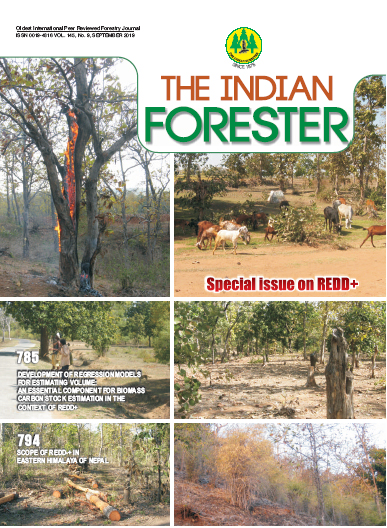
Scope of REDD+ in Eastern Himalaya of Nepal
DOI:
https://doi.org/10.36808/if/2019/v145i9/148678Keywords:
Land Cover Mapping, Forest Change Analysis, REDD , Nepal.Abstract
Changing forest landscape is a global phenomenonand an indicator of deforestation and forest degradation. Utilization of remote sensing technology gives a unique opportunity to map, estimate and identifythese indicators. This study aims to trace land cover patterns and the forest cover change in five districts namely, Sankhuwasabha, Bhojpur, Sunsari, Dhankuta and Terhathum of Nepaloverthe last eighteen years (2000-2018). Time series land cover maps of three years (2000, 2010 and 2018) were derived from Landsat satellite imagery. These maps along with the use of GIS tools helped in identifying the land cover change matrix. Adding to that, spatial metrics were computedto analyze landscape fragmentation and degradation of land cover. The results highlight two main points: 1) overall, forest growth in terms of the area across the region with some deforestation and forest degradation still evident. Forest land to cropland conversion still observed to be the dominant cause of change, 2) a gradual decreasing trend in landscape fragmentation observed which could be due to restricted human interferences indicating improved management of land resources. The knowledge of existing forest cover change helps in managing the forest in an efficient manner and could be an area for further REDD+ programs.References
Achard F., Stibig H.J., Eva H.D., Lindquist E.J., Bouvet A., Arino O. and Mayaux P. (2010). Estimating tropical deforestation from Earth observation data. Carbon Management., 1: 271-287.
Acharya A.K. and Kafle N. (2009). Land degradation issues in Nepal and its management through agroforestry. The Journal of Agriculture and Environment., 10:115-123.
ADB (2016). Key Indicators for Asia and the Pacific 2016. Asian Development Bank, Mandaluyong City, Philippines.
Adhikari J. and Hobley M. (2013). Everyone is leaving-who will sow our fields? The Effects of Migration from Khotang District to the Gulf and Malaysia. Himalaya, the Journal of the Association for Nepal and Himalayan Studies. 35:(1):11-23.
Adhikari S., Baral H., Sudhir Chitale V. and Nitschke C.R. (2018). Perceived Changes in Ecosystem Services in the Panchase Mountain Ecological Region, Nepal. Resources, 8: 4.
Allison K. (2017). Improving REDD+ (Reducing Emissions from Deforestation and Forest Degradation) Programs, University of Washington.
Banskota A., Kayastha N., Falkowski M.J., Wulder M.A., Froese R.E. and White J.C. (2014). Forest Monitoring Using Landsat Time Series Data: A Review. Canadian J. Remote Sensing, 40: 362-384.
CBS (2012). National Population and Housing Census 2011 (National Report). Government of Nepal. Central Bureau of Statistics, Kathmandu, Nepal.
CBS (2014). Environment Statistics of Nepal 2013. Central Bureau of Statistics: Kathmandu, Nepal.
CBS (2017). National Climate Change Impact Survey 2016. A Statistical Report. Central Bureau of Statistics, Kathmandu, Nepal.
De Sy V., Herold M., Achard F., Asner G.P., Held A., Kellndorfer J. and Verbesselt J. (2012). Synergies of multiple remote sensing data sources for REDD+ monitoring. Current Opinion in Environmental Sustainability, 4:696-706.
DFRS (2015). State of Nepal's Forest. Forest Resource Assessment Nepal, Department of Forest Research and Survey (DFRS). Kathmandu, Nepal.
Dhakal B.N. and Khanal N.R. (2018). Causes and Consequences of Fragmentation of Agricultural Land: A Case of Nawalparasi District, Nepal. Geographical J. Nepal, 11: 95-112.
Gilani H., Murthy M., Bajracharya B., Karky B., Koju U.A., Joshi G., Karki S. and Sohail M. (2015). Assessment of Change in Forest Cover and Biomass Using Geospatial Techniques to Support REDD+ Activities in Nepal, 60.
ICIMOD (2018). Land cover map of Nepal. Retrieved from http://rds.icimod.org/Home/ on 20/05/2019.
Jaquet S., Schwilch G., Hartung-Hofmann F., Adhikari A., Sudmeier-Rieux K., Shrestha G., Liniger H.P. and Kohler T. (2015). Does outmigration lead to land degradation? Labour shortage and land management in a western Nepal watershed. Applied Geography, 62:157-170.
Jaquet S., Kohler T. and Schwilch G. (2019). Labour Migration in the Middle Hills of Nepal: Consequences on Land Management Strategies. Sustainability, 11(5):1-19.
Li X., Chen W.Y., Sanesi G. and Lafortezza R. (2019). Remote Sensing in Urban Forestry: Recent Applications and Future Directions. Remote Sensing, 11: 1144.
MacLean M.G. and Congalton R.G. (2010). Mapping and analysis of fragmentation in southeastern New Hampshire. American Society of Photogrammetry & Remote Sensing/Cartography & GIS 2010 Fall Specialty Conference. Orlando, Florida. 15-19 November, 2010.
McGarigal K. and Cushman S.E. (2015). FRAGSTATS v4: Spatial Pattern Analysis Program for Categorical and Continuous Maps.Computer software program produced by the authors at the University of Massachusetts. Amherst.
McRoberts R.E., Cohen W.B., Naesset E., Stehman S.V. and Erkki T. (2010). Using remotely sensed data to construct and assess forest attribute maps and related spatial products. Scandinavian J. Forest Research, 340-367.
MoFSC (2010). Nepal's Readiness Preparation Proposal (2010-2013). Ministry of Forests and Soil Conservation. Singh Durbar, Kathmandu, Nepal.
MoFSC (2017). National Forest Reference Level of Nepal (2000-2010). Ministry of Forests and Soil Conservation. Singh Durbar, Kathmandu, Nepal.
Murthy M.S.R., Gilani H., Karky B.S., Sharma E., Sandker M., Koju U.A., Khanal S. and Poudel M. (2017). Synergizing community-based forest monitoring with remote sensing: A path to an effective REDD+MRV system. Carbon Balance and Management, 12:19.
Netro R.E. (2015). REDD+ as a tool of global forest governanc. International spectator, 50:60-73.
Oldekop J.A., Sims K.R.E., Karna B.K., Whittingham M.J. and Agrawal A. (2019). Reductions in deforestation and poverty from decentralized forest management in Nepal. Nature Sustainability, 2: 421-428.
Pandey S.S. (2014). An Evaluation of REDD+ in Community Managed Forest: a case study from Nepal. University of Southern Queensland.
Paudel B., Zhang Y., Yan J., Rai R. and Li L. (2019). Farmers' perceptions of agricultural land use changes in Nepal and their major drivers. J. Environmental Management, 235: 432-441.
Reiche J., Hamunyela E., Verbesselt J., Hoekman D. and Herold M. (2018). Improving near-real time deforestation monitoring in tropical dry forests by combining dense Sentinel-1 time series with Landsat and ALOS-2 PALSAR-2. Remote Sensing of Environment, 204:147-161.
Rey Benayas J. (2007). Abandonment of agricultural land: an overview of drivers and consequences. CAB Reviews: Perspectives in Agriculture, Veterinary Science, Nutrition and Natural Resources, 2:14-28.
Rimal B., Keshtkar H., Sharma R., Stork N., Rijal S. and Kunwar R. (2019). Simulating urban expansion in a rapidly changing landscape in eastern Tarai, Nepal. Environmental Monitoring and Assessment, 191(4): 255:1-114.
Shrestha B. (2011). The land development boom in Kathmandu Valley (Commercial Pressure on Land Issues). Kathmandu: CDS and Rome, ILC.
Shrestha S., Shrestha U.B. and Bawa K. (2018). Socio-economic factors and management regimes as drivers of tree cover change in Nepal. PeerJ., 6: e4855:1-25.
Singh S., Tanvir Hassan S.M., Hassan M. and Bharti N. (2019). Urbanisation and water insecurity in the Hindu Kush Himalaya: Insights from Bangladesh, India, Nepal and Pakistan. Water Policy, 1-24.
Thapa R.B. and Murayama Y. (2009). Examining spatiotemporal urbanization patterns in Kathmandu Valley, Nepal: Remote sensing and spatial metrics approaches. Remote Sensing, 1: 534-556.
Thapa R.B. (2012). Monitoring landscape change in Kathmandu metropolitan region using multi-temporal satellite imagery. In Proceeding: SPIE 8528 Earth Observing Missions and Sensors: Development, Implementation and Characterization 8528p. Kyoto 9 November, 2012, Japan.
Thapa R.B., Motohka T., Watanabe M. and Shimada M. (2015). Time-series maps of aboveground carbon stocks in the forests of central Sumatra. Carbon Balance and Management, 10:23.
Trisurat Y., Shirakawa H. and Johnston J.M. (2019). Land-use/land-cover change from socio-economic drivers and their impact on biodiversity in Nan Province, Thailand. Sustainability, 11: 1-22.
UNFCCC (2017). Report of the technical assessment of the proposed forest reference level of Nepal submitted in 2017.
Winarso G., Vetrita Y., Purwanto A.D., Anggraini N., Darmawan S. and Yuwono D.M. (2015). Mangrove above ground biomass estimation using combination of Landsat 8 and alos palsar data. ACRS 2015-36th Asian Conference on Remote Sensing: Fostering Resilient Growth in Asia, Proceedings, 12: 85-96.
Downloads
Downloads
Published
How to Cite
Issue
Section
License
Unless otherwise stated, copyright or similar rights in all materials presented on the site, including graphical images, are owned by Indian Forester.


