
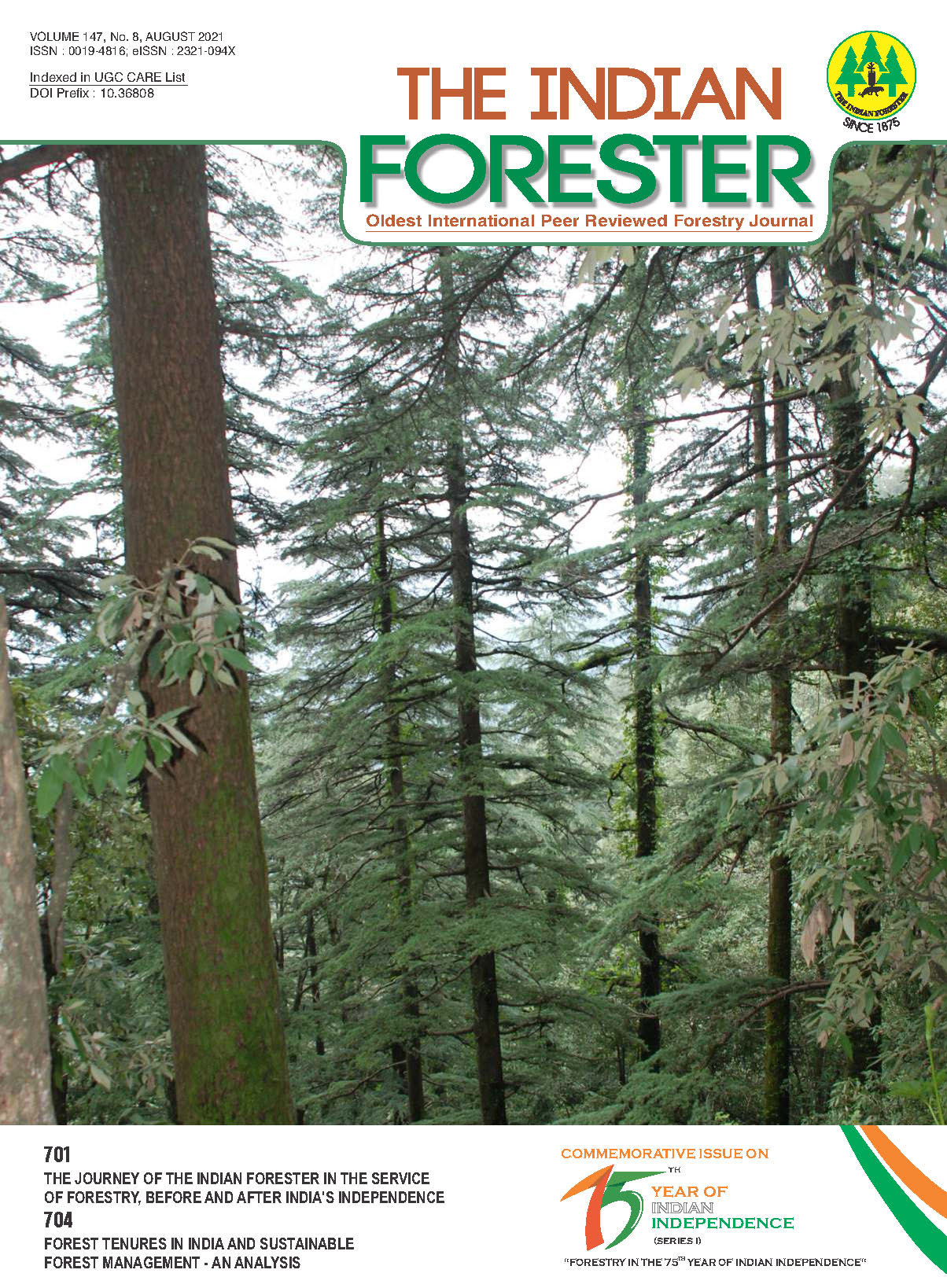
Forest Tenures in India and Sustainable Forest Management - An Analysis
DOI:
https://doi.org/10.36808/if/2021/v147i8/164959Keywords:
Forest Land Tenure, Rights, Forest Conservation Act, Forest Boundary Maps, Forest Rights Act, PESA.Abstract
Forest land tenures in India has remained diverse, plural with multiple legal and customary regimes and reflects a continuum of rights while manifesting state, community and individual ownership. Forest tenure arrangements and practices have undergone major changes starting from the initiation of notification as Reserve or Protected Forest under the Indian Forest Act 1927, community participation in forest conservation under JFM approach, PESA, and recently settlement of Individual/community rights and community forest resources under the Forest Rights Act.
This paper provides an overview of forest tenure, drawing from global discourses and analyze the historical as well as recent transitions around forest governance, in the context of forest tenures in India. While doing so, it also discusses implications on sustainable forest management and make specific recommendations.
References
Agrawal A., Chhatre A. and Hardin R. (2008). Changing governance of the world's forests. Science, 320, 1460-1462.
Anon. (2017). Standard Operating Procedure for Georeferencing of Forest Block Boundary through DGPS survey, Notification No.22572400112016 10F (cons) 77/2016/14097 F&E dated 4.7.2017
Bansal A.K., Madhu Verma, Rajesh Kumar, Swapan Mehera, Priyanka Batra (2012). REDD + manual for Practitioners, Indian Institute of Forest Management, 20p.
Bansal A.K. (2013a). Forest Conservation Act - Applications and Implications, One India One People March 2013, pp:12-14.
Bansal A.K. (2013b). Evolution of JFM to JFM+ for Sustainable forest Management, A dialogue on Ecology and Environment - V, Swadhina, June, pp: 3-7.
Bansal A.K., Vinod Kumar, Subhdarshi Mishra (2013). GIS based planning and monitoring of JFM treatment areas under JICA assisted Odisha Forestry Sector Development Project, Indian Forester Volume, 139(8): 674-682.
Food and Agriculture Organization of the United Nations FAO) (2011). Reforming forest tenures - Issues, Principles and Processes, FAO Forestry paper 165, 92p.
Food and Agriculture Organization of the United Nations (FAO) (2002). Land Tenure and Rural Development (Rome: FAO), http://www.fao.org/DOCREP/005/Y4307E/y4307e00.htm#.
Food and Agriculture Organization of the United Nations (FAO) (2020). Global Forest Resources Assessment 2020: Main Report, Rom (2020), 10.4060/ca9825en
Forest Research Institute (2011). Status of Joint Forest management in India, Proceedings of National workshop on JFM, 27-28 June 2011, 63p.
Katila Pia, McDermott Constance, Larson Anne, Aggarwal Safia, Giessen Lukas (2020). Forest tenure and the Sustainable Development Goals - A critical view, Forest Policy and Economics, Volume 120,102294, ISSN 13899341,https://doi.org/10.1016/j.forpol.2020.102294.
Larson A.M., Barry D. and Dahal G.R. (2010). New rights for forest-based communities? Understanding processes of forest tenure reform. International Forestry Review, 12(1): 78-96.
Mahapatra A.K. and Shackleton C.M. (2011). Has deregulation of non-timber forest product controls and marketing in Orissa state (India) affected local patterns of use and marketing. Forest Policy and Economics, 13(8): 622-629.
OSTROM E. 1990. Governing the commons. Cambridge University Press, New York.
Planning Commission, Government of India, (2012). Report of the Steering Committee on Forests, Environment, Wildlife and Climate Change, March, 110p.
POFFENBERGER M. (2001). Communities and forest management in Southeast Asia. IUCN, Gland, Switzerland.
Rights and Resources Initiative. (2018). At a crossroads: Consequential trends in recognition of community-based forest tenure from 2002-2017. Rights and Resources Initiative, Washington DC, USA.
ROE D. (2008). The origins and evolution of the conservation poverty debate: a review of key literature, events and policy processes. Oryx., 42(4): 491-503.
Sunderlin W.D., Hatcher J. and Liddle M. (2008). From exclusion to ownership? Challenges and opportunities in advancing forest tenure reform. Washington, DC: Rights and Resources Initiative.
TERI (2020). Development of Forest Governance Model in context of Community Forest Resource Rights, for the Ministry of Tribal Affairs, Government of India, 190p.
Upadhyay R.K. (2011). Policy changes in status of forest ownership from 1865 to 2006 - Journey from Government owned to private ownership - An analysis, Indian Forester, 137(8a):21-26
World Bank (2019). India - Land governance assessment report (LGAF): national synthesis report (English). Washington, D.C.
http://documents.worldbank.org/curated/en/63201150486626 5171/India-Land-governance-assessment-report-LGAF-national-synthesis-report.
Downloads
Downloads
Published
How to Cite
Issue
Section
License
Unless otherwise stated, copyright or similar rights in all materials presented on the site, including graphical images, are owned by Indian Forester.


