
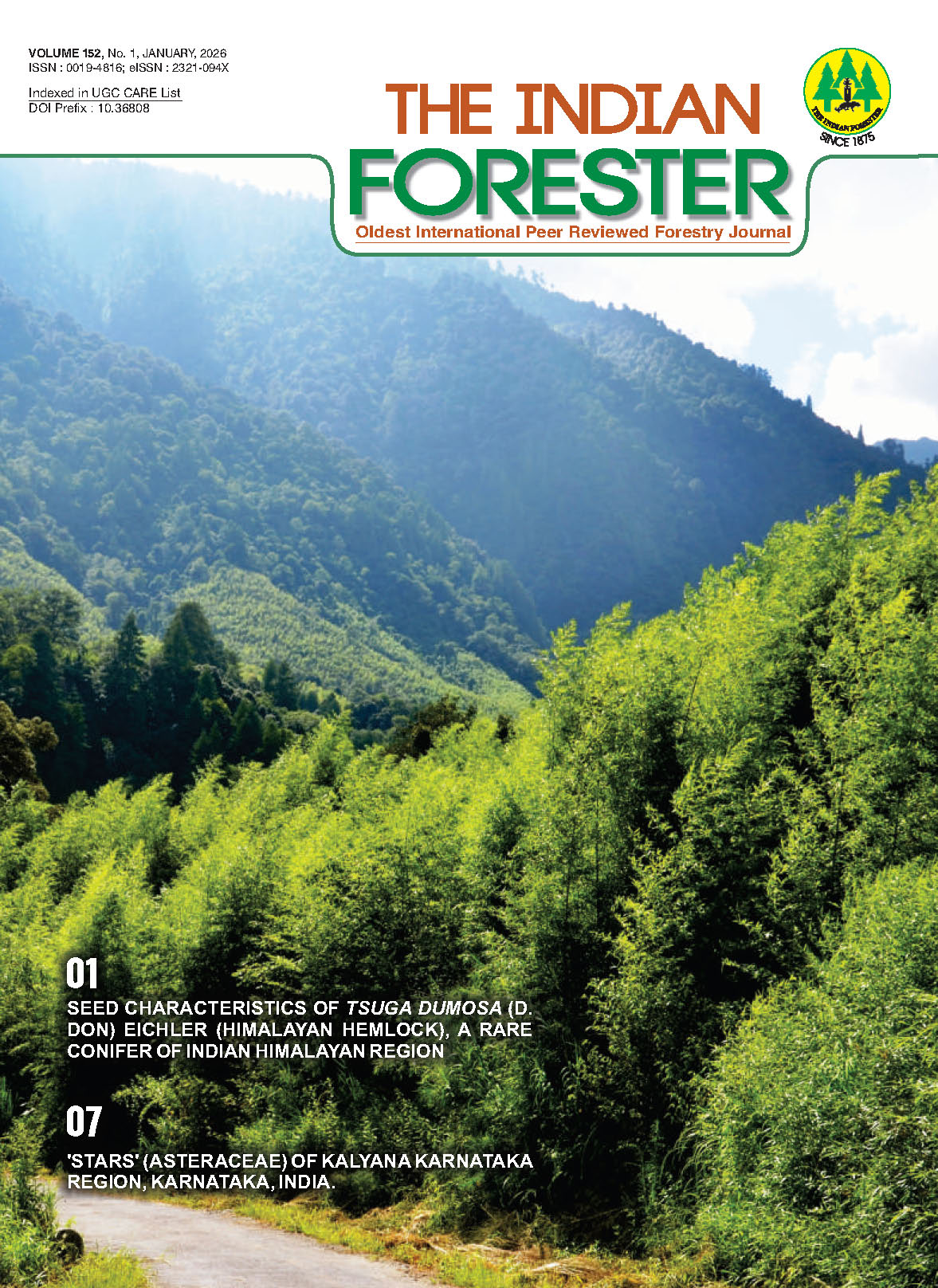
Seed Characteristics of Tsuga dumosa (D. Don) Eichler (Himalayan Hemlock), A Rare Conifer of Indian Himalayan Region
DOI:
https://doi.org/10.36808/if/2026/v152i1/170980Keywords:
Tsuga dumosa, seed, dormancy, cold stratification, Himalayan conifers, germination, GA3 treatment, forest regeneration.Abstract
A wide range of conifer species originate in the Himalayas and hold major ecological and silvicultural value, with Tsuga dumosa being one of the lesser-studied species. This study examines its seed biology, characteristics, and germination behavior. The work was carried out at the Forest Tree Seed Laboratory, FRI Dehradun, from February to June 2022. Cones of T. dumosa were collected from Tilthin, Narayanashram, Dharchula, Pithoragarh Uttarakhand, and the seeds were extracted in the Seed Processing Unit, FRI Dehradun. The seed germination experiments and other seed parameters were recorded as per ISTA rules (2010). Additionally, the use of right growth promoter in the appropriate concentration on germination enhancement was evaluated. The seeds of Tsuga dumosa were small and light, with 500 seeds weighing only 1.49 g and about 331 seeds per gram, indicating a high seed number and very low individual seed weight showing the species adaptation for wind dispersal. The average length was recorded about 8.8 mm with the wing and 3.9 mm without the wing, while the width was around 3.9 mm (with wing) and 2.6 mm (without wing). Seeds treated with 300 ppm GA3 for 24 hours and stratified for 30 days i.e.T2 showed the highest germination percentage of 34.66%.Seedlings of T. dumosa showed gradual improvement from T0 (control) to T3 (45 days stratification+ vermiculite), with increases in root length (1.02–1.43 cm), shoot length (2.16–2.77 cm), and collar diameter (0.67–0.79 mm), indicating better growth in treated conditions. MGT was lowest in T1 (15 days stratification), meaning seeds germinated faster there, while PV, GV, GI, and VI were all higher in treated groups (especially T2), showing stronger and more vigorous seedling performance compared to the control.
References
Chandra J.P. and Chauhan P.S. (1977). Note on germination of spruce seeds with gibberellic acid. Indian Forester, 102(10): 721–725.
Chandran M. (2011). Working plan Pithoragarh Forest Division Part II (October 2011 to September 2021). Uttarakhand Forest Department.
Dhungana B.P. and Chhetri V.T. (2024). Population structure and regeneration of Tsuga dumosa and Abies spectabilis across altitudinal gradient in Rasuwa district, central Nepal. Banko Janakari, 34(1): 40–50. DOI: https://doi.org/10.3126/banko.v34i1.64672
Dvorak W.S., Kietzka J.E. and Donahue J.K. (1996). Threeyear growth of provenances of Pinus gregii in the tropics and subtropics. Forest Ecology and Management, 83(1–2): 132–137. DOI: https://doi.org/10.1016/0378-1127(95)03673-3
Fehr W.R. and Weber C.R. (1968). Mass selection by seed size and specific gravity in soybean populations. Crop Science, 8: 551–554. DOI: https://doi.org/10.2135/cropsci1968.0011183X000800050014x
Gautam J., Bhardwaj S.D. and Panwar P. (2005). Storage studies on seeds of Chir Pine (Pinus roxburghii). Seed Research, 33(1): 73–77.
Gosling P. (2007). Raising trees and shrubs from seed: Practice guide. Forestry Commission.
Gratzer G., Darabant A., Chhetri P.B., Rai P.B. and Eckmüllner O. (2004). Light response of six tree species in the conifer belt of the Bhutan Himalayas. Canadian Journal of Forest Research, 34: 1093–1107. DOI: https://doi.org/10.1139/x03-281
Havill N.P., Campbell C.S., Vining T.F., Le Page B., Bayer R.J. and Donoghue M.J. (2008). Phylogeny and biogeography of Tsuga (Pinaceae) inferred from nuclear ribosomal ITS and chloroplast DNA sequence data. Systematic Botany, 33(3): 478–489. DOI: https://doi.org/10.1600/036364408785679770
Indian Council of Forestry Research and Education. (2013). Forest types of India (pp. 1–473). ICFRE.
Isik K. (1986). Altitudinal variation in Pinus brutia Ten.: Seed and seedling characteristics. SilvaeGenetica, 35(2–3): 58–67.
Khullar P., Thapliyal R.C., Beniwal B.S., Vakshasya R.K. and Sharma A. (1991). Forest seed. ICFRE.
Li L., Yang J.-N., Cui K., Trotter R.T., Li Z.-H., Li G.-Q. and Liao S.-X. (2013). Strobili and seed characteristics of Tsuga dumosa and its relationship with environmental factors. Chinese Journal of Plant Ecology, 37(9): 820–829. DOI: https://doi.org/10.3724/SP.J.1258.2013.00086
Miehe G., Miehe S., Böhner J., Bäumler R., Ghimire S.K., Mugtahari K., Chaudhary R.P., Subedi M., Jha P.K. and Pendry C. (2015). Vegetation ecology. In G. Miehe C. Pendry, and R.P.
Chaudhary (Eds.), Nepal: An introduction to the natural history, ecology and human environment of the Himalayas (pp. 385–426). Royal Botanic Garden Edinburgh.
Mughal A.H. and Thapliyal R.C. (2013). Effect of chilling temperature, chilling duration and incubation temperature on germination characteristics of Cedrus deodara (D. Don) (G. Don) seeds. International Journal of Chemical Studies, 1(1): 111.
Naithani H.B. (2018). Phyto-sociological study of Hemlock Forest from Uttarakhand, India. Indian Forester, 144(7): 626–631.
Olson J.S., Stearns F.W. and Nienstaedt H. (1959). Eastern Hemlock seeds and seedlings: Response to photoperiod and temperature (Bulletin 620).
Osmaston A.E. (1927). A forest flora of Kumaon (pp. 1-605). Superintendent Government Press.
Rawat B.S., Khanduri V.P. and Sharma C.M. (2008). Beneficial effects of cold-moist stratification on seed germination behaviors of Abies pindrow and Picea smithiana. Journal of Forestry Research, 19(2): 125–130. DOI: https://doi.org/10.1007/s11676-008-0021-8
Roy M.S., Thapliyal R.C. and Phartyal S.S. (2004). Seed source variation in cone, seed and seedling characteristics across the natural distribution of Himalayan low level pine Pinus roxburghii Sarg. SilvaeGenetica, 53(3): 116–122. DOI: https://doi.org/10.1515/sg-2004-0021
Salazar R. (1989). Genetic variation of 16 provenances of Acacia mangium at nursery level in Turrialba, Costa Rica. Commonwealth Forestry Review, 68(4): 263–272.
Singh H. (1978). Embryology of gymnosperms. Berlin, Germany: Gebrüder Borntraeger. 302 pp.
Singh O. (1998). Seed maturity indices in Silver fir (Abies pindrow). Indian Forester, 124(3): 243–246.
Singh O. and Kachari J. (2006). Seed maturity indices in Khasi pine (Pinus kesiya). Indian Forester, 132(12): 1689–1691.
Sofi P. and Bhardwaj S.D. (2008). Effect of seed weight and pre-sowing treatments on germination and seedling growth of Cedrus deodara. SKUAST Journal of Research, 10: 156–160.
Spurr S.H. (1944). Effect of seed weight and seed origin on the early development of eastern white pine. Journal of the Arnold Arboretum, 25: 467–481. DOI: https://doi.org/10.5962/p.185507
Thapliyal M. (Ed.). (2014). Advances in forest seed science & technology. Greenfields Publishers.
Troup R.S. (1921). The silviculture of Indian trees: Volume 3: Lauraceae to Coniferae (pp. 1155–1156). Clarendon Press.
Wangda P. and Ohsawa M. (2006). Structure and regeneration dynamics of dominant tree species along an altitudinal gradient in a dry valley slope of the Bhutan Himalaya. Forest Ecology and Management, 230: 136–150. DOI: https://doi.org/10.1016/j.foreco.2006.04.027
Willan R.L. (1985). A guide to forest seed handling (FAO Forestry Paper 20/2). Rome, Italy: Food and Agriculture Organization of the United Nations.
Downloads
Downloads
Published
How to Cite
Issue
Section
License
Unless otherwise stated, copyright or similar rights in all materials presented on the site, including graphical images, are owned by Indian Forester.


